


Understanding automatic vs manual transmission is key for any driver, whether you’re buying your first car or are just curious about what’s happening under the hood. That “clunk” or smooth surge you feel when you accelerate isn’t magic; it’s a complex system of gears and clutches doing its job. For many, the choice between pressing a clutch pedal or simply putting the car in “Drive” defines their entire driving experience. But what’s really going on when your car shifts? Let’s break down the mechanics behind the different gearbox systems to see how they actually work.
For the past five years, I’ve dedicated my time to exploring the world of cars, from the simplest maintenance tasks to the intricate details of their mechanics. My name is Sharmin, and my passion is digging into automotive tools, customization, and technology to understand not just how things work, but why they were designed that way. This curiosity has led me to research and write about these topics, aiming to make complex concepts clear and accessible for everyone. My goal isn’t to be a certified mechanic, but to share the knowledge I’ve gathered through hands-on learning and deep research, helping you feel more connected to the vehicle you drive every day.
The Classic Manual Transmission: You’re in Control
The manual transmission, often called a “stick shift,” is the original gearbox. It gives the driver direct control over gear selection, creating a more engaged and connected driving experience. For many enthusiasts, this is the purest form of driving. At its heart, a manual transmission is a brilliant piece of mechanical engineering that relies on the driver to manage the flow of power from the engine to the wheels.
How a Manual Transmission Works
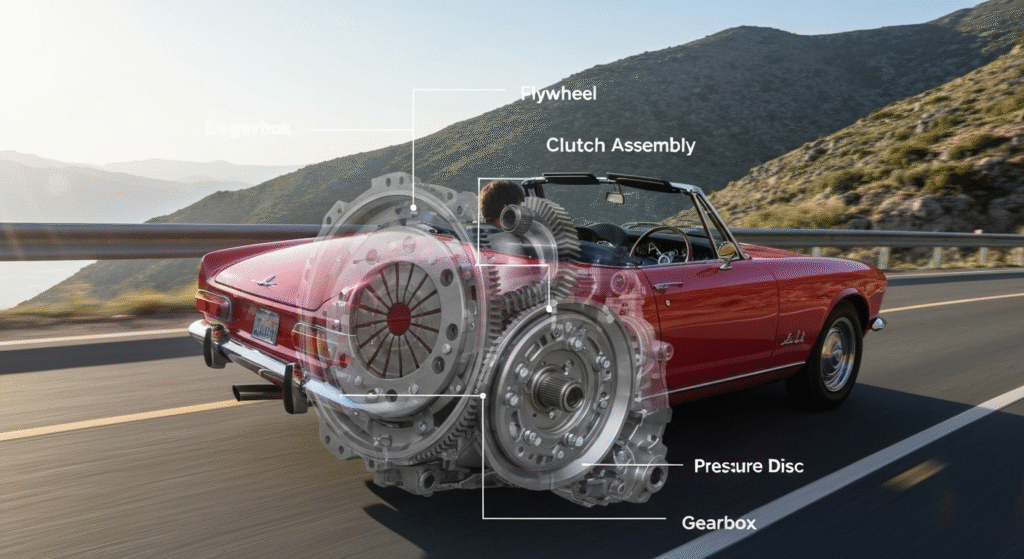
To understand a manual transmission, you need to know its three main players: the clutch, the gear selector (shifter), and the gearbox itself.
- The Clutch: Think of the clutch as a light switch for your engine’s power. The engine is always spinning when the car is on. The clutch is a mechanism that connects and disconnects that spinning engine from the transmission. It consists of two main parts: a clutch disc and a pressure plate, which are pressed against the engine’s flywheel.
- When the clutch pedal is up: The pressure plate firmly holds the clutch disc against the flywheel. Power flows from the engine, through the clutch, to the transmission, and finally to the wheels. The connection is complete.
- When you press the clutch pedal down: This action pulls the pressure plate away from the clutch disc, creating a small gap. The engine is now disconnected from the transmission. No power reaches the wheels, even though the engine is still running. This interruption is what allows you to safely shift gears without causing damage.
- The Gear Selector: The shifter in your hand is connected to a series of rods and forks inside the gearbox. When you move the shifter, these forks slide different-sized gears into place along a shaft. Each pair of gears creates a different gear ratio, which determines how many times the engine has to turn to make the wheels turn once. Low gears (like 1st and 2nd) provide more torque for starting, while high gears (like 5th and 6th) provide more speed for cruising.
The process of changing gears is a three-step dance:
- Press the clutch pedal to disconnect the engine.
- Move the shifter to select the desired gear.
- Slowly release the clutch pedal to smoothly reconnect the engine at the new gear ratio.
Driving Characteristics and Feel
Driving a manual car is an active experience. You learn to listen to the engine’s sound to know when to shift. You feel the car’s vibrations and feedback through the clutch pedal and shifter. This direct connection is what many drivers love.
| Pros of Manual Transmission | Cons of Manual Transmission |
| More Engaging: Provides a direct, connected feel to the car. | Steep Learning Curve: Takes time and practice to master. |
| Better Control: Allows precise control over power and speed. | Difficult in Traffic: Constant clutching can be tiring. |
| Often Cheaper: Manual cars typically have a lower purchase price. | Potential for Driver Error: Easy to stall or grind gears. |
| Potentially More Fuel Efficient (Older Cars): In the past, manuals were more efficient, though modern automatics have closed this gap. | Less Common: Fewer new models are offered with a manual option. |
Export to Sheets
The Conventional Automatic Transmission: Convenience is King
The traditional automatic transmission revolutionized driving by removing the need for a clutch pedal and manual shifting. Its primary goal is to provide a smooth, effortless driving experience, especially in stop-and-go city traffic. Instead of a clutch that physically disconnects the engine, it uses a clever fluid-based device called a torque converter.
The Magic of the Torque Converter
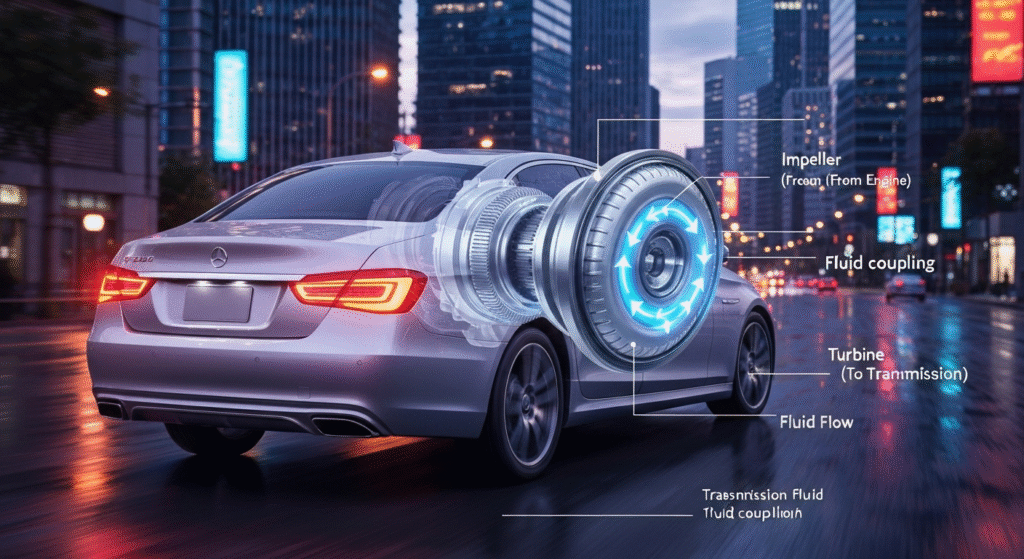
The torque converter is the heart of a conventional automatic transmission. It replaces the clutch and serves the same basic purpose: to manage the power flow from the engine to the gearbox. But it does so in a completely different way.
Imagine two fans facing each other in a sealed room. One fan is connected to the engine (let’s call it the impeller), and the other is connected to the transmission (the turbine). Now, fill the room with transmission fluid.
- When the engine is idling, the impeller spins slowly. It pushes the fluid around, causing the turbine to spin, but not with enough force to move the car. This is why you can sit at a red light with the car in “Drive” without stalling.
- When you press the gas pedal, the engine and the impeller spin much faster. The force of the moving fluid becomes very strong, spinning the turbine with enough power to turn the wheels and move the car forward.
This fluid coupling allows for a smooth transfer of power without any direct physical connection. Inside the gearbox, a complex system of planetary gearsets is used to create the different gear ratios. A computer, known as the Transmission Control Unit (TCU), monitors your speed and how hard you’re pressing the gas pedal to decide the perfect moment to shift gears automatically.
How it Operates in Daily Driving
For the driver, the experience is simple: you select “D” for Drive and the car handles the rest. You’ll feel slight shifts as the transmission moves through its gears, but modern automatics have become so smooth that these shifts are often barely noticeable. This “set it and forget it” nature is what makes automatic transmissions the most popular choice for daily commuters.
| Pros of Automatic Transmission | Cons of Automatic Transmission |
| Easy to Use: No clutch pedal or manual shifting required. | Less Engaging: Can feel disconnected from the driving experience. |
| Great for Traffic: Reduces driver fatigue in stop-and-go conditions. | More Complex: Repairs can be more expensive and complicated. |
| Smooth Operation: Modern automatics provide seamless shifts. | Slightly Less Efficient (Historically): Older models used more fuel. |
| Widely Available: The standard option on most new cars today. | Heavier: The components add more weight to the vehicle. |
Export to Sheets
CVT (Continuously Variable Transmission): The Gearless Wonder
A Continuously Variable Transmission, or CVT, is a type of automatic transmission that does away with traditional gears entirely. Instead of having a fixed number of gear ratios (like 4, 6, or 8 speeds), a CVT can constantly and smoothly change through an infinite range of effective gear ratios. This design has one primary goal: maximizing fuel efficiency.
A Different Approach to Shifting
The most common type of CVT works with a simple and brilliant system: two variable-diameter pulleys connected by a high-strength steel belt or chain.
- One pulley is connected to the engine, and the other is connected to the wheels.
- Each pulley is shaped like a cone and can move in and out, changing its effective diameter.
- To create a “low gear” for starting, the engine-side pulley becomes narrow, and the wheel-side pulley becomes wide.
- To create a “high gear” for cruising, the engine-side pulley becomes wide, and the wheel-side pulley becomes narrow.
Because these pulleys can change their diameter continuously, the CVT can keep the engine running at its most efficient RPM (revolutions per minute) for a given speed. Think of it like a dimmer switch for a light, which provides a full range of brightness, compared to a three-way bulb that only has a few set levels.
What it Feels Like to Drive
Driving a car with a CVT is a unique experience. When you accelerate, the engine revs up to its optimal power band and stays there, while the car’s speed smoothly increases. There are no shift points or jolts. This can feel strange to drivers accustomed to traditional transmissions and has been nicknamed the “rubber band effect.”
To make the experience feel more familiar, many automakers now program “simulated” shift points into their CVTs. When you accelerate hard, the transmission will mimic the feel of a conventional automatic by slightly dropping and raising the engine RPM, even though there are no actual gears changing.
| Pros of CVT | Cons of CVT |
| Excellent Fuel Efficiency: The main benefit of a CVT. | “Rubber Band” Feel: The driving sensation can feel unnatural. |
| Extremely Smooth Ride: No gear shifts mean no jolts. | Not Ideal for High-Performance: Generally not used in sports cars. |
| Keeps Engine in Optimal Power Band: Provides efficient power delivery. | Perceived Reliability Concerns: Early CVTs had issues, though modern ones are much better. |
| Lighter and Simpler Design: Fewer moving parts than a traditional automatic. | Repair Costs: If it fails, it is often replaced rather than repaired. |
Export to Sheets
For a more in-depth look at the engineering behind CVTs, you can check out this detailed explanation from HowStuffWorks.
Dual-Clutch Transmission (DCT): The Best of Both Worlds?
A Dual-Clutch Transmission (DCT), sometimes called a direct-shift gearbox (DSG), is an advanced type of automated transmission. It aims to combine the lightning-fast shifts and efficiency of a manual gearbox with the convenience of an automatic. It’s essentially two manual transmissions working in perfect harmony within one housing.
Two Clutches, One Gearbox
Here’s the clever part: a DCT uses two separate clutches.
- Clutch 1 controls the odd-numbered gears (1, 3, 5, 7).
- Clutch 2 controls the even-numbered gears (2, 4, 6, R).
While you are driving in 1st gear, the transmission’s computer has already pre-selected 2nd gear on the other clutch. The moment it’s time to shift, Clutch 1 disengages at the exact same instant that Clutch 2 engages. The entire process takes just milliseconds, resulting in a shift that is faster than any human could perform with a manual. There is no interruption in power flow to the wheels, which is why DCTs are a favorite in high-performance and racing cars.
The Driving Sensation
The hallmark of a DCT is its incredibly crisp and rapid gear changes. During spirited driving, the shifts are instantaneous and satisfying. However, because it’s mechanically similar to a manual, a DCT can sometimes feel a little jerky at very low speeds, such as when crawling through a parking lot or in heavy traffic. The clutches are trying to feather themselves just like a person would in a manual car, and it can sometimes lack the buttery smoothness of a traditional torque converter automatic in those specific situations.
| Pros of Dual-Clutch Transmission (DCT) | Cons of Dual-Clutch Transmission (DCT) |
| Extremely Fast Shifting: Near-instantaneous gear changes. | Can Be Jerky at Low Speeds: Not as smooth as a torque converter. |
| Excellent Fuel Efficiency: No power loss from a torque converter. | Higher Cost and Complexity: More expensive to manufacture and repair. |
| Engaging Driving Experience: Feels sporty and responsive. | Potential Long-Term Reliability: Can be more sensitive to maintenance. |
| Offers Both Automatic and Manual Modes: Can be driven as a full auto or shifted manually with paddles. | Heavier than a Manual: The dual-clutch mechanism adds weight. |
Head-to-Head Comparison: Which Transmission is Right for You?
Choosing a transmission ultimately comes down to your priorities as a driver. What do you value most: engagement, convenience, fuel economy, or performance?
| Feature | Manual Transmission | Automatic Transmission | CVT | Dual-Clutch Transmission (DCT) |
| Driving Feel | Engaging, connected, high driver involvement. | Smooth, effortless, relaxed. | Seamless, linear, sometimes feels disconnected. | Sporty, rapid, can be slightly jerky at low speed. |
| Best Use Case | Enthusiast driving, winding roads. | City commuting, daily driving. | Maximizing fuel economy, highway cruising. | Performance driving, track use. |
| Fuel Efficiency | Good to Excellent | Good (modern units are very efficient) | Excellent | Excellent |
| Purchase Cost | Lowest | Moderate | Moderate | Highest |
| Maintenance & Repair Cost | Generally lower (clutch is a wear item). | Can be high for major repairs. | Often requires full replacement if it fails. | Can be very high due to complexity. |
| Complexity | Low | High | Moderate | Very High |
Frequently Asked Questions (FAQs)
Can an automatic transmission be as fuel-efficient as a manual? Yes. In the past, manual transmissions were almost always more fuel-efficient. However, with advancements like 8, 9, and 10-speed automatics and sophisticated computer controls, many modern automatic cars now get the same or even better gas mileage than their manual counterparts.
Are CVTs reliable? Modern CVTs have become much more reliable than the early versions, which gave the technology a bad reputation. Like any transmission, their longevity depends on proper maintenance, including regular fluid changes according to the manufacturer’s schedule. Many major brands like Nissan, Honda, and Toyota use them with great success.
Is a dual-clutch transmission considered an automatic or a manual? It’s best described as an “automated manual transmission.” It has the internal workings of a manual gearbox but is operated automatically by computers and hydraulics. You drive it just like an automatic (with P-R-N-D), but it functions mechanically like two manuals working together.
Which transmission is cheapest to maintain? Generally, a manual transmission is the cheapest to maintain over the long term. The main wear item is the clutch, which is a predictable and relatively affordable replacement. Traditional automatics, CVTs, and DCTs are more complex, and if a major internal component fails, the repair or replacement costs can be significantly higher.
Conclusion
The world of transmissions is more diverse than ever. Each system—from the raw, mechanical connection of a manual to the effortless convenience of an automatic, the supreme efficiency of a CVT, and the lightning-fast performance of a DCT—offers a unique solution to the challenge of getting power to the wheels. There is no single “best” option; the right choice is the one that best fits your driving style, your daily routine, and your personal preferences. The next time you get behind the wheel, you’ll have a much better idea of the incredible engineering at work with every shift.


