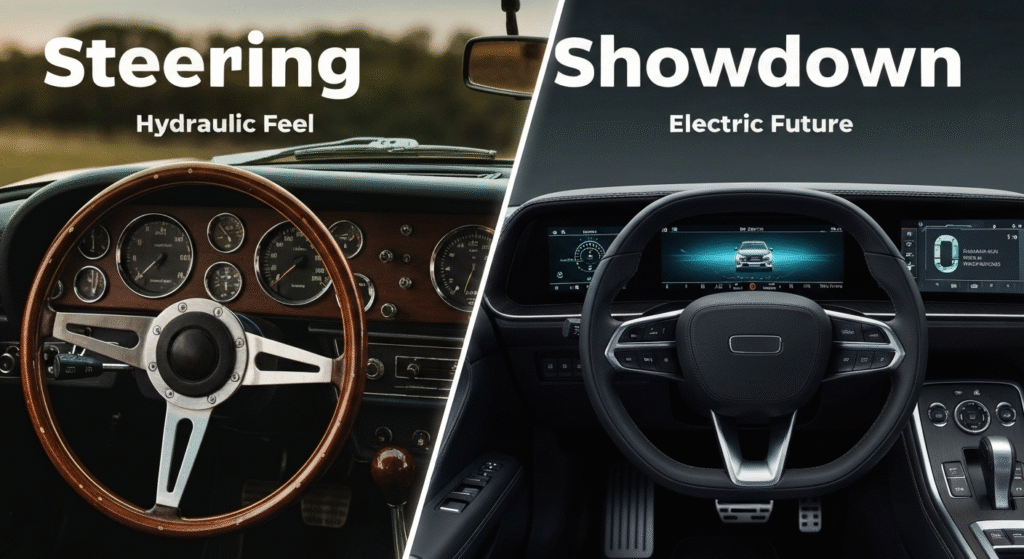

Ever driven an older car and then hopped into a brand new one? One of the first things you probably noticed was the steering. An older car might have felt heavier, more connected to the road, almost like you could feel every pebble through the wheel. In contrast, the new car’s steering likely felt light, smooth, and almost effortless, especially in a parking lot. This difference isn’t in your head. It comes down to a fundamental change in automotive technology: the shift from Hydraulic Power Steering (HPS) to Electric Power Steering (EPS). Understanding this change explains so much about the feel of modern vehicles.
For years, I’ve been fascinated by the “why” behind how cars work and feel. My journey has taken me from reading service manuals in my garage to exploring the engineering choices that shape our driving experience. This passion for understanding cars from the inside out—covering everything from automotive tools to maintenance quirks—has driven me to share what I’ve learned. My goal isn’t just to list facts but to connect the dots, offering clear explanations and context that bring the machinery to life. I believe that knowing how your car works makes you a better, more confident driver.
The Classic Feel: How Hydraulic Power Steering Works
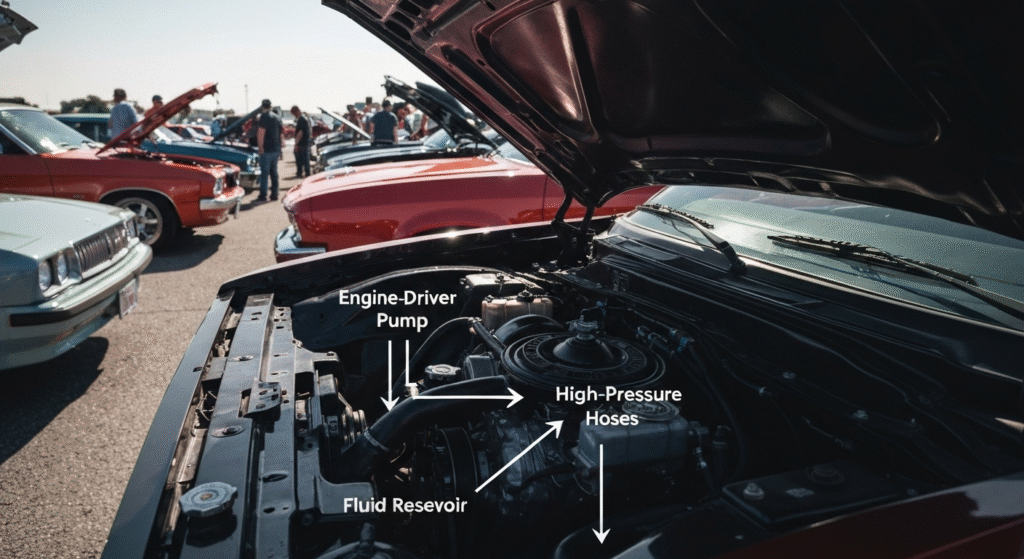
For decades, hydraulic power steering was the undisputed king. If you drove a car made before 2010, chances are you’ve experienced it. The entire system is built on a simple yet effective principle: using pressurized fluid to help you turn the wheels.
Think of it like using a hydraulic jack to lift a heavy object. You apply a small amount of force to the handle, and the fluid pressure multiplies that force to do the heavy lifting. HPS works in a similar way for your steering.
Key Parts of a Hydraulic System
A traditional HPS system is a collection of mechanical parts working in harmony.
- The Pump: This is the heart of the system. A belt connected to the engine’s crankshaft constantly spins this pump.
- The Fluid Reservoir: This plastic container holds the power steering fluid, which is usually a type of hydraulic oil.
- Hoses and Lines: High-pressure hoses carry the fluid from the pump to the steering gear and back.
- The Steering Rack or Gearbox: This is the clever part. It contains a rotary valve and a piston. When you turn the steering wheel, the valve directs high-pressure fluid to one side of the piston, pushing the steering rack left or right.
How It All Comes Together
Here’s the step-by-step breakdown. When the engine is running, the pump is always working, circulating fluid through the system under pressure. When you start to turn the steering wheel, the rotary valve opens precise channels. This directs the high-pressure fluid to the side of the rack that will help your turn. For example, if you turn right, fluid pushes the piston to assist the rack’s movement to the right. This assistance is what makes turning the wheel so much easier than in a car with no power steering at all.
What really defined this system was its feedback. Because you were physically connected to the front wheels through a column and a system of pressurized fluid, you could feel the road. The forces acting on the tires would push back against the hydraulic pressure, and those subtle changes would travel right up to your hands. This is the communicative, raw feel that many driving enthusiasts miss.
The Modern Standard: Unpacking Electric Power Steering (EPS)
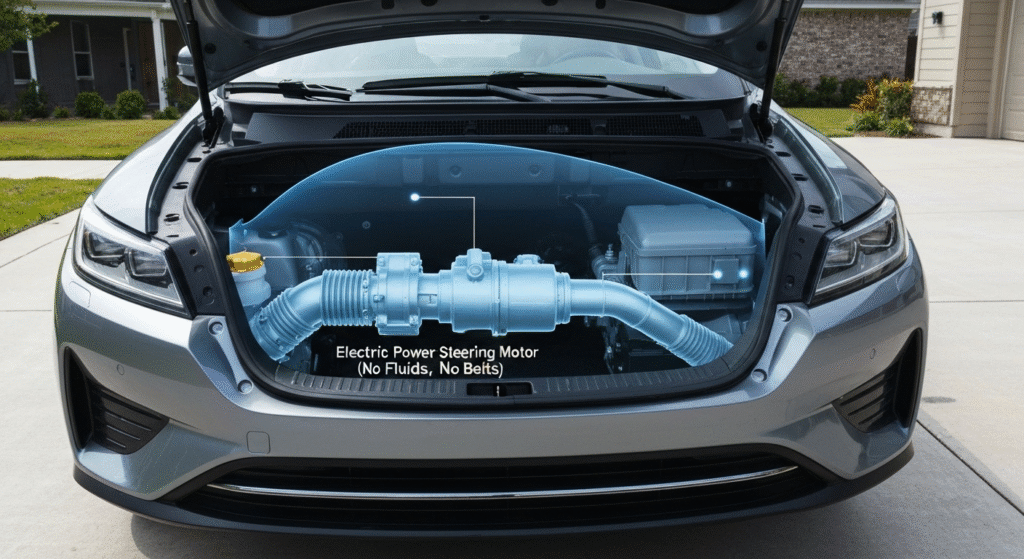
Electric power steering is the new normal. Almost every new passenger car today uses an EPS system. Instead of a messy, engine-driven hydraulic setup, it uses a simple electric motor to provide steering assistance. This change is as significant as the switch from carburetors to fuel injection.
The core idea is to provide power steering on demand. Why have a pump constantly running and wasting energy when you only need help during a turn? EPS solves this by only activating when you need it.
The Brains and Brawn of EPS
An EPS system is more about electronics and sensors than belts and fluids.
- Electric Motor: This is the muscle. Depending on the design, it can be mounted on the steering column (column-assist), the pinion gear (pinion-assist), or directly on the steering rack (rack-assist).
- Sensors: The system relies on data. A torque sensor measures how much effort you’re applying to the steering wheel. A steering angle sensor tracks the wheel’s position and speed of rotation. It also uses the vehicle speed sensor.
- Electronic Control Unit (ECU): This is the brain. It takes information from all the sensors and decides exactly how much assistance the electric motor should provide.
The Digital Process
When you turn the wheel in a car with EPS, a series of events happens in milliseconds. The torque sensor detects your input and sends a signal to the ECU. The ECU also looks at your vehicle’s speed. It then instantly calculates the right amount of assistance and tells the electric motor to apply that force, making the wheel turn easily.
This digital control is what makes EPS so different. Early versions were often criticized for feeling numb or artificial, like playing a video game. There was no direct fluid link to transmit road feel. Instead, engineers had to program the “feel” into the system. The good news is that they’ve gotten incredibly good at it. Modern EPS systems can feel sharp, responsive, and natural.
Head-to-Head: EPS vs. HPS Showdown
Putting the two systems side-by-side reveals why the industry made such a decisive switch. While hydraulic steering has its charms, the practical advantages of electric systems are hard to ignore in the context of modern car design.
Here’s a direct comparison of the key attributes of each system:
| Feature | Hydraulic Power Steering (HPS) | Electric Power Steering (EPS) |
| Power Source | Engine-driven hydraulic pump | Electric motor powered by the car’s electrical system |
| Steering Feel | Generally direct, raw, and communicative | Can be lighter and more isolated; highly tunable by engineers |
| Fuel Efficiency | Lower. The pump constantly draws power from the engine. | Higher. The motor only uses power when steering assistance is needed. |
| Complexity | Mechanically complex with a pump, belts, hoses, and fluid. | Electronically complex with sensors, an ECU, and wiring. |
| Maintenance | Requires regular fluid checks and changes. Prone to leaks. | Generally maintenance-free. No fluid or belts to replace. |
| Tunability | Very limited. The feel is largely fixed by the mechanical design. | Highly programmable. Can offer different modes (e.g., Comfort, Sport). |
| Packaging | Bulky. Requires space in the engine bay and routing for hoses. | Compact. The motor can be placed in various locations. |
Pros and Cons at a Glance
Let’s break it down into a simple list.
Hydraulic Power Steering (HPS)
- Pros:
- Excellent Road Feedback: The direct fluid connection provides a natural, intuitive feel of the road surface and tire grip.
- Proven and Robust: The technology was refined over decades and is mechanically very strong.
- Cons:
- Inefficient: The pump is always running, creating a “parasitic loss” that reduces fuel economy by a noticeable amount (often 1-2 MPG).
- Maintenance-Intensive: Fluid needs to be monitored and changed, and leaks from old hoses or seals are a common and messy problem.
- Bulky and Heavy: The system adds weight and takes up valuable space in a crowded engine bay.
Electric Power Steering (EPS)
- Pros:
- Superior Fuel Efficiency: The “on-demand” nature of the system saves significant amounts of fuel over the life of the car.
- Enables Modern Driver-Assist Features: Technologies like lane-keep assist and automatic parking are only possible because a computer can control the EPS motor.
- Reliable and Maintenance-Free: No fluid, no pump, and no belts mean fewer parts to fail or maintain.
- Highly Tunable: Manufacturers can easily adjust steering weight and responsiveness to match a car’s character or even offer selectable driving modes.
- Cons:
- Can Lack Feedback: Especially in early or poorly tuned systems, the steering can feel numb and disconnected from the road.
- Complex Electronics: While mechanically simpler, a failure in a sensor or the ECU can be difficult and expensive to diagnose and repair.
Why Did a Good Thing Go Away? The Big Switch to Electric
If hydraulic steering offered such great feel, why did nearly every automaker abandon it? The answer comes down to a few overwhelmingly practical reasons that have reshaped the modern automobile.
The #1 Reason: Fuel Economy and Emissions
This is the big one. In a world with increasingly strict government regulations on fuel economy and CO2 emissions, every little bit counts. The hydraulic pump in an HPS system is always spinning when the engine is on, whether you’re turning or not. This constant drag on the engine is a waste of power. By switching to an electric motor that only draws energy when needed, automakers could instantly gain a 3-5% improvement in fuel efficiency. That’s a huge win that helps them meet regulatory targets. According to a study cited by the U.S. Department of Energy, this switch has saved billions of gallons of fuel.
Packaging and Manufacturing Simplicity
Engine bays are tighter than ever. An HPS system is bulky. It has a pump, a reservoir, a pulley, a belt, and a network of high-pressure hoses. An EPS system gets rid of all that. The motor and control unit are often integrated directly onto the steering column or rack. This frees up precious space, simplifies the vehicle assembly process, and reduces the number of parts an automaker has to source and install.
The Gateway to Modern Technology
This might be the most important reason for the future of cars. EPS is a foundational technology for almost all modern Advanced Driver-Assistance Systems (ADAS). Think about features that can actively steer the car:
- Lane Keep Assist: The system’s camera sees the lane markings and uses the EPS motor to make small steering corrections to keep you centered.
- Automatic Parking: The car measures the parking space and uses the EPS motor to steer itself into the spot perfectly.
- Lane Centering & Traffic Jam Assist: In slow traffic, the car can essentially steer itself, keeping a safe distance from other vehicles.
None of these innovations are possible with a hydraulic system because there’s no way for a computer to control the steering. EPS provides the digital interface that allows the car’s central brain to take over steering inputs.
It’s Not Always the Same: Understanding Variable-Assist Steering
One of the best features of modern steering is how it adapts to your speed. It provides lots of assistance at low speeds to make parking and city driving a breeze, but it firms up at high speeds for better stability and control on the highway. This is called variable-assist steering.
In the old days, some high-end hydraulic systems offered a version of this. They used complex, speed-sensitive valves to alter the hydraulic pressure. It worked, but it was another layer of mechanical complexity.
With EPS, this feature is incredibly simple to implement. It’s all in the software. The steering ECU constantly monitors the vehicle’s speed. It’s programmed with a “map” that tells the electric motor exactly how much power to apply at any given speed.
- At 5 mph (parking lot): The ECU commands the motor to provide maximum assistance.
- At 70 mph (highway): The ECU tells the motor to provide very little, or even no, assistance.
This programmability allows for a perfect blend of low-speed comfort and high-speed confidence, a trick that was much harder to pull off with hydraulics.
The Ghost in the Machine: What Exactly is Steering Feedback?

When enthusiasts talk about missing hydraulic steering, what they’re really talking about is steering feedback, also known as “road feel.” But what is it?
In simple terms, feedback is the flow of information from the road surface, through the tires and suspension, and up to the driver’s hands via the steering wheel. It’s the subtle vibrations, tugs, and changes in resistance that tell you what the front tires are doing. It tells you if the road is slippery, if you’re about to lose grip in a corner, or if you’re driving over a rough patch.
In an HPS system, this feedback loop is very direct. The forces from the tires literally push back on the steering rack, which in turn pushes against the hydraulic fluid. You feel these pressure changes directly. It’s an analog, physical connection.
The challenge with EPS is that the electric motor can act as a buffer, isolating the driver from these forces. There is no direct fluid connection to transmit those subtle vibrations. Therefore, engineers have to simulate feedback. They write complex algorithms for the ECU that try to replicate the feeling of a hydraulic system. They can program in resistance that builds up as you turn, or even introduce small vibrations to mimic road texture. This is why some EPS systems feel great and others feel numb—it all comes down to the quality of the programming.
Frequently Asked Questions (FAQs)
Can I convert my hydraulic steering to electric?
While technically possible with custom fabrication, it’s an extremely complex and expensive job that is not practical for most cars. It involves changing the steering rack, wiring, sensors, and ECU, and is generally not worth the cost or effort.
Is electric power steering less reliable than hydraulic?
No, EPS is generally considered more reliable. It has fewer moving parts and no fluid to leak or degrade. While an electronic failure is possible, it’s far less common than hydraulic issues like pump failure or hose leaks on older cars.
Why does my EPS steering sometimes feel “notchy” or “weird”?
This can sometimes be caused by a software issue, a failing sensor, or a problem with the electric motor itself. In some early EPS designs, a slightly “sticky” or notchy feeling around the center point was a common characteristic, but this has been largely engineered out of modern systems.
Do all new cars use electric power steering?
Almost all new passenger cars and SUVs use EPS. Some heavy-duty trucks and high-performance specialty sports cars may still use hydraulic or electro-hydraulic systems, but they are becoming increasingly rare due to the overwhelming benefits of EPS.
Conclusion: A Clearer Future for Steering
The move from hydraulic to electric power steering marks a major evolution in how we connect with our cars. While the raw, unfiltered feedback of a well-tuned hydraulic system is something many drivers will rightly miss, the change was unavoidable and, for the most part, beneficial. Electric power steering’s efficiency, reliability, and role as a key enabler for modern safety and convenience features have made it the clear winner for the future of automotive design.
The early numbness of EPS is steadily being replaced by sophisticated, tunable systems that can deliver both comfort and a satisfying sense of control. Engineers can now craft a car’s steering feel with software, tailoring it to be light and easy in a family SUV or sharp and heavy in a sports sedan. So, while the feel has changed, the innovation continues, promising a future where our cars are not only smarter and safer but also more engaging to drive than ever before.